Three steps are enough to understand the idea. The paper gives the full formulation.
STEP 1
Learn a prior from the LLM's own weights.
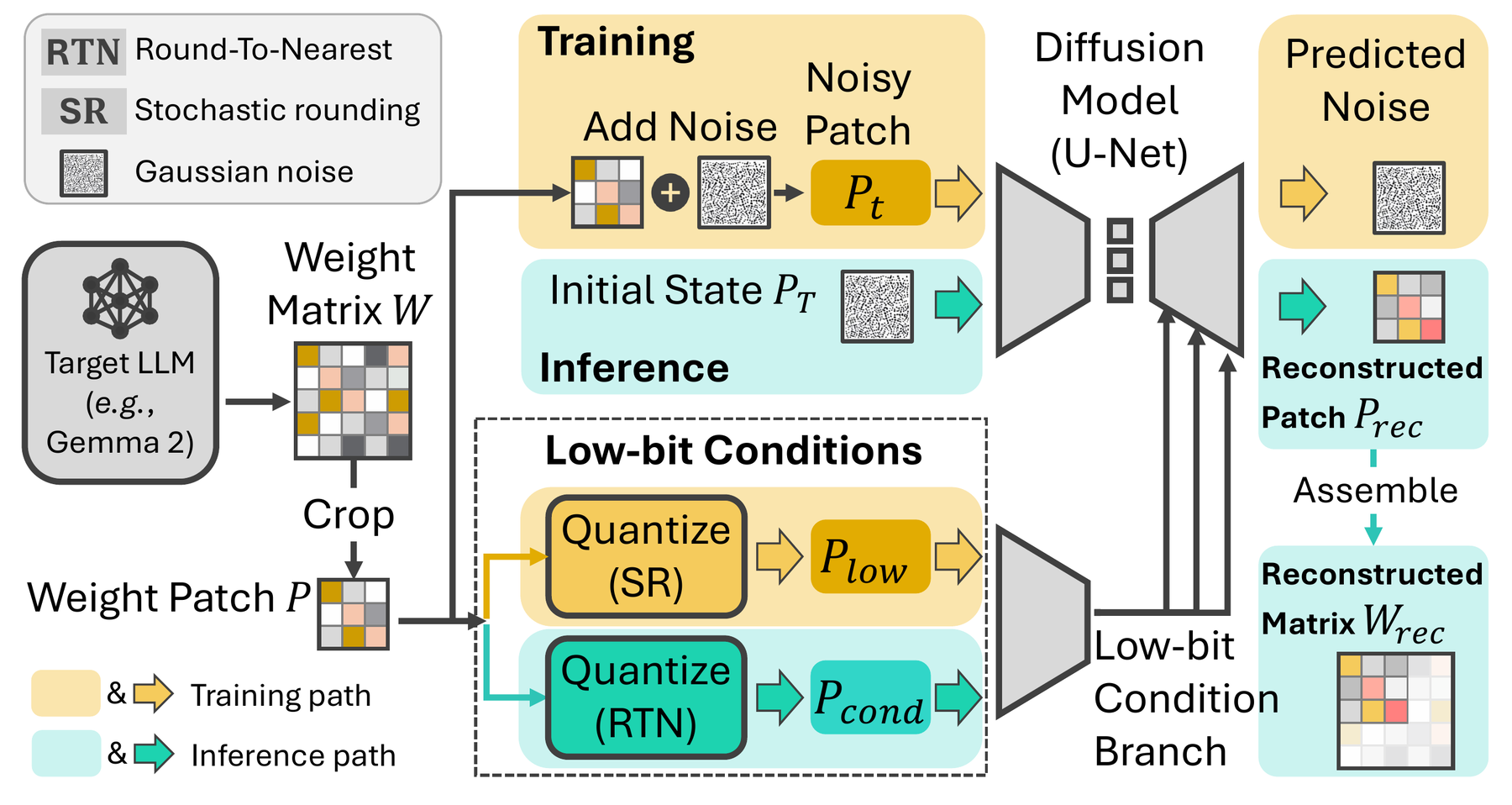
ReRound trains a conditional diffusion model on small patches from the pretrained LLM's weight matrices. The model learns to recover a continuous full-precision patch from a low-bit observation.
Later, RTN-quantized patches are fed to the diffusion model to reconstruct a continuous weight matrix. The reconstructed matrix guides rounding; it is not the final deployed weight matrix.
The prior comes from the pretrained model's own weight matrices.
STEP 2
Start from RTN, then reconsider uncertain weights.
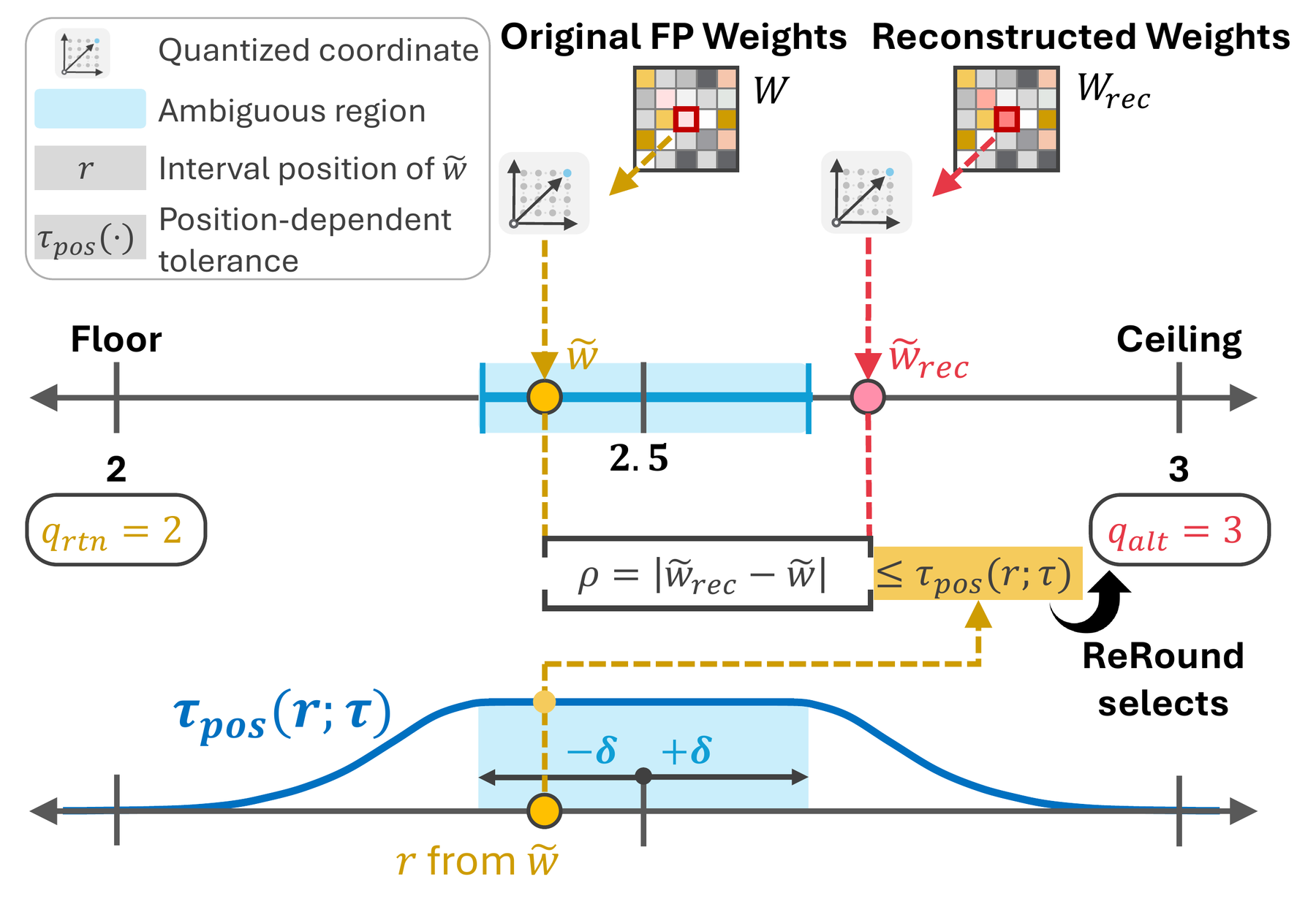
After scaling, each weight still has to be assigned to an integer level. ReRound starts from the RTN choice. If the reconstructed weight points to the opposite adjacent level, ReRound considers changing that assignment.
The blue tolerance curve allows more reconstruction guidance near the midpoint and less near the integer levels. If the reconstruction is too far from the scaled weight, ReRound keeps the RTN assignment.
Near the midpoint, the reconstruction can provide useful guidance for the rounding direction.
STEP 3
Choose the candidate that best preserves the weight matrix.
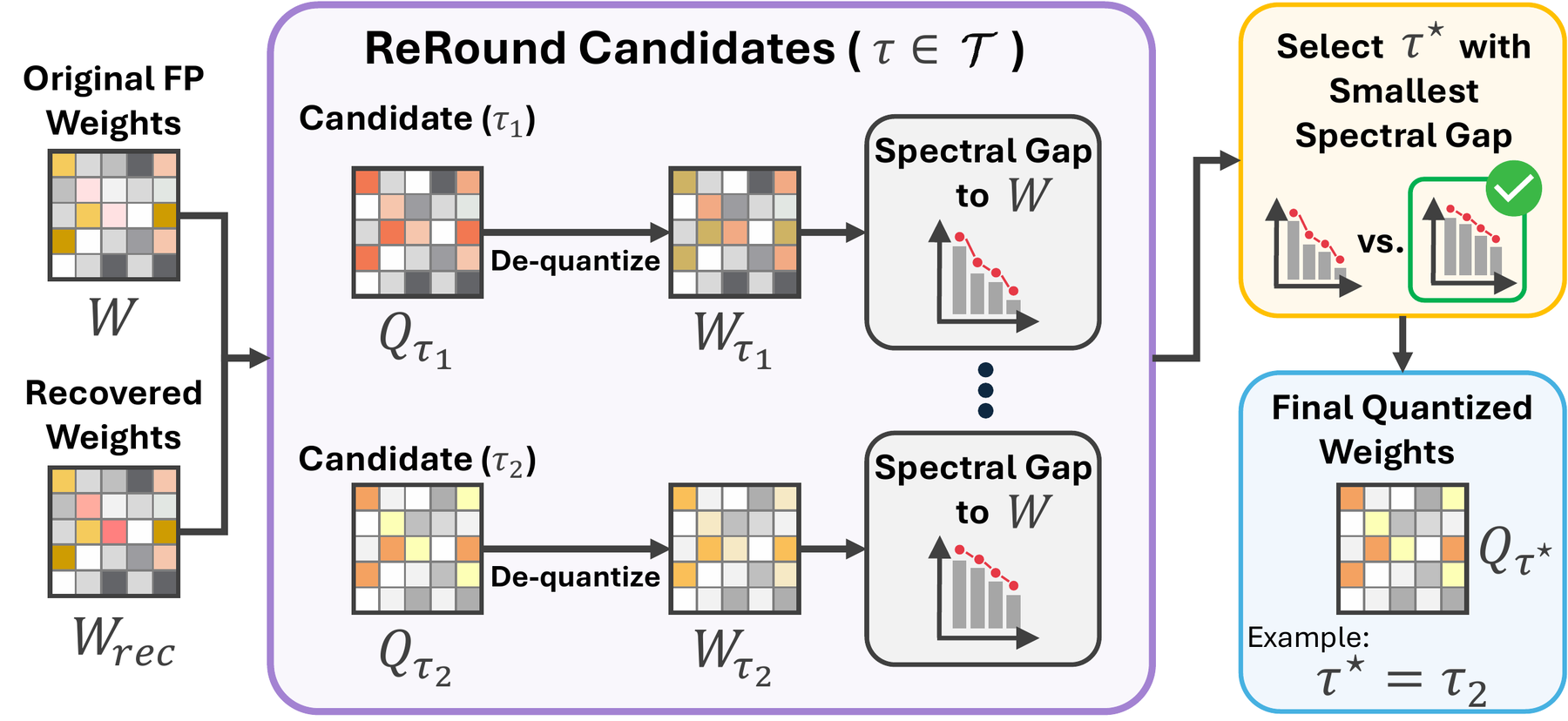
Different tolerance settings produce a small set of candidate quantized matrices. ReRound dequantizes each candidate only for comparison and checks how closely its leading singular values match those of the original full-precision matrix.
The candidate with the smallest spectral gap is kept. This selection uses model weights only—no calibration text or task examples.
The final candidate is the one with the smallest spectral discrepancy from the original matrix.